
Executive Summary
B2B organizations invest heavily in content. Editorial calendars stay full, publishing velocity stays high, and dashboards track activity across every channel. Yet sales friction persists. Buyers hesitate. Deals stall. Content sits unused.
The problem is not a lack of effort. It is a lack of alignment.
| Most content problems are not creation problems. They are relevance problems. Content fails when it does not reflect how buyers actually evaluate information, build confidence, and make decisions. |
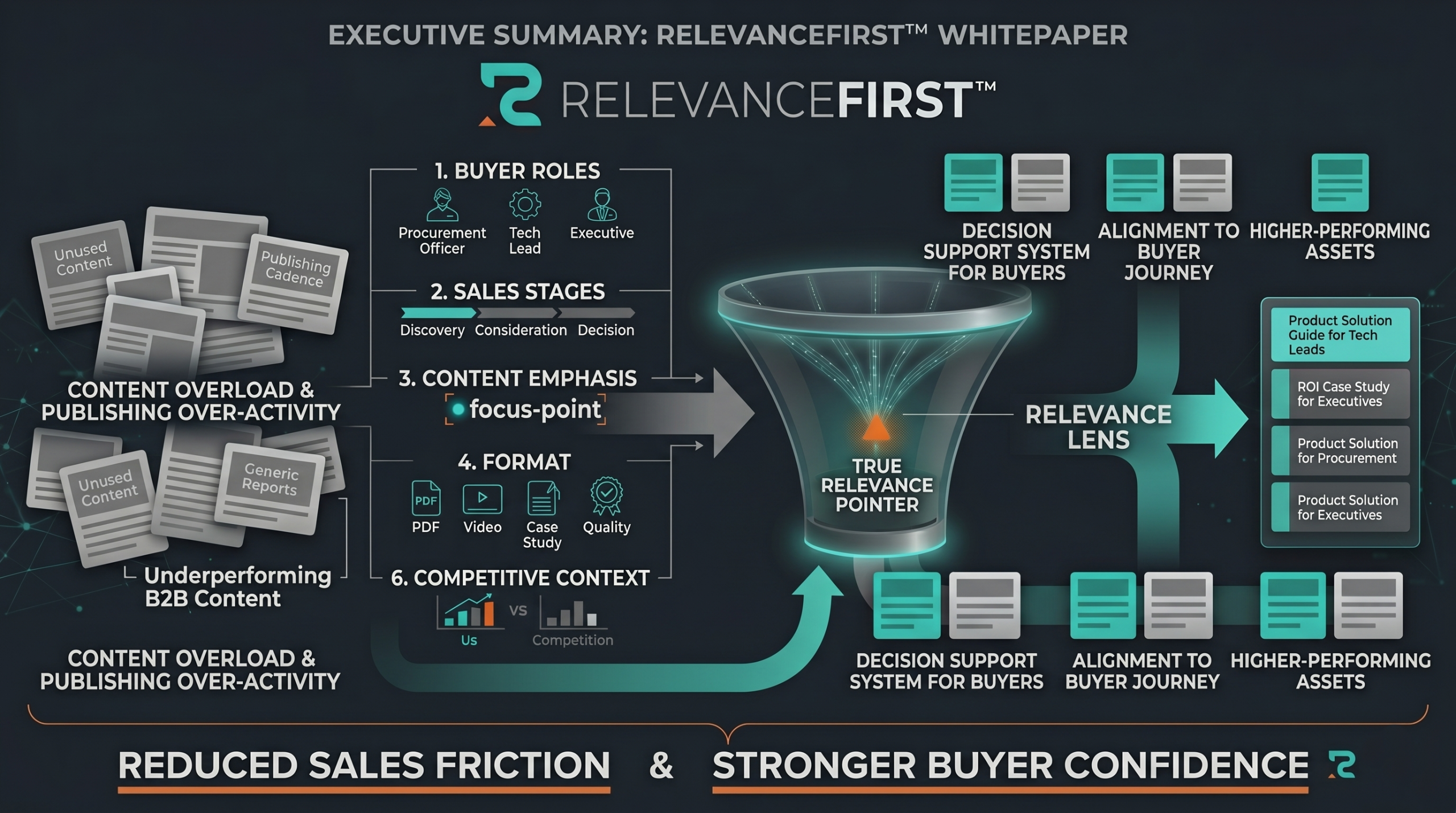
RelevanceFirst™ was designed to address this directly. It is a structured, buyer-centric methodology for evaluating content across buyer roles, sales stages, format, quality, and competitive context. Rather than treating content as a publishing output, RelevanceFirst treats content as a decision support system for buyers.
Content Doctor™ operationalizes this methodology as a decision intelligence platform, enabling marketing teams to diagnose misalignment, prioritize action, and generate new content only when relevance demands it.
1. The Content Problem RelevanceFirst™ Was Designed to Solve
Modern B2B content strategies are optimized for production. Teams plan editorial calendars, assign formats, measure output, and distribute across channels. When results disappoint, the default response is to produce more.
Buyers experience something very different. They encounter fragmented messaging, inconsistent depth, missing explanations, and content that assumes confidence before it exists. They struggle to understand applicability, risk, and how to justify a decision internally.
This gap between content activity and buyer clarity is the problem RelevanceFirst and Content Doctor was designed to solve.
How This Plays Out in Practice
| The Publishing Treadmill A SaaS marketing team publishes three blog posts per week to ‘feed the funnel.’ Quarter over quarter, traffic grows but conversion rates stay flat. The team responds by publishing more. No one stops to ask whether the content actually supports buyer decision-making at any specific stage. Activity is high. Confidence is low. |
| The Late-Stage Ghost A B2B services firm has 60+ awareness articles and a strong editorial presence. But deals regularly go dark after the initial discovery call. Sales reports that finance stakeholders enter late in the process asking for ROI models and risk assessments that do not exist. The marketing team has been building for the top of the funnel. No one built for the CFO. |
| The Persona Profile Trap A company spent months building detailed buyer personas based on job titles, firmographics, and past behavior. When deals stalled, they assumed the personas were right and the content was wrong. In reality, their personas described who buyers were, not how they made decisions. The IT security stakeholder blocking deals had specific compliance objections that no persona had ever documented. |
| The Content Count Audit A marketing director runs a quarterly content audit and finds 200+ assets covering every funnel stage. She reports to leadership that coverage is strong. Close rates remain flat. The decision-stage content is mostly product feature sheets. Financial authorities need justification tools with defensible assumptions. Feature sheets cannot carry that weight, regardless of how many exist. |
| The Creation Reflex After a lost deal analysis shows buyers asked for ‘more proof,’ the team commissions eight new case studies. Six months later and a significant budget spent, the case studies are live but deals still stall at the same point. The actual problem was that existing case studies lacked specific, quantified outcomes. The team created more of what was already insufficient. |
These are not outlier scenarios. They reflect how most B2B content programs operate when relevance is not the organizing principle.
2. What Relevance Means in B2B Content
In RelevanceFirst™, relevance is defined operationally.
| Relevance is the degree to which content aligns with buyer needs at a specific moment, for a specific role, in support of a specific decision. |
Relevance requires alignment across buyer roles, sales stages, products and services, and business goals. It is contextual, not universal.
Relevance is not:
- Personalization for its own sake
- Keyword optimization
- Channel performance
- Content consistency alone
- Volume
Content is relevant when it helps a buyer move forward with confidence. That is the only standard that matters.
3. The Core Principles of RelevanceFirst™
RelevanceFirst is grounded in five principles that guide how content is evaluated, managed, and improved.
| The Five Principles of RelevanceFirst™ 1. Content is evaluated in context, not isolation. 2. Buyers matter more than channels. 3. Purpose matters more than volume. 4. Emphasis matters more than labels. 5. Confidence precedes conversion. |
These principles represent a deliberate departure from content strategy models built around publishing cadence, channel optimization, and funnel labeling. Each one reorients the evaluation from what teams produce to what buyers need.
4. How Buyers Actually Evaluate Information
B2B buying is not a linear funnel. It is a confidence-building process.
Buyers do not move cleanly from awareness to decision in a single direction. They evaluate information repeatedly as their understanding deepens, new stakeholders enter, and internal scrutiny increases. Across most B2B decisions, buyers continuously ask:
- Whether they understand the problem correctly
- Whether there is a business case to address the problem
- Whether the solution is credible
- Whether it applies to their specific context
- What risks exist if the decision is wrong
- How the decision can be justified internally
These evaluations do not happen once. They recur, and they often intensify later in the buying process.
Why This Breaks Traditional Content Strategy
Content strategies built around linear publishing stages often fail to support this reality. They assume that once a buyer has seen awareness content, that need is permanently resolved.
RelevanceFirst rejects that assumption.
Instead, it aligns content to confidence states, recognizing that understanding, credibility, applicability, risk assessment, and justification must often be supported multiple times, in different formats, for different roles.
| Content is relevant when it supports the confidence a buyer needs at the moment it is evaluated, not when it matches a predefined funnel label. |
| Real-World Consequence A mid-market software company had excellent awareness content and a steady flow of demo requests. But 40% of deals stalled after the demo, right when financial stakeholders entered the process. The team assumed they had a sales problem. They had a content problem. No late-stage justification assets existed for the financial authority role. |
5. The RelevanceFirst™ Evaluation Model
RelevanceFirst evaluates content using a multi-dimensional model that reflects how buyers actually evaluate information. At its foundation, it assesses relevance across five interacting dimensions.
| The Five Evaluation Dimensions Buyer Roles: Who holds decision responsibility at each stage? Sales Stages: The buyer’s current level of confidence. Content Emphasis: How a piece weights different confidence states. Business Goals: The strategic intent the content is meant to support. Content Goals: What must change in the reader’s mind to achieve the business goal |
Relevance does not exist in any single dimension. It emerges at the intersection of all five.
Single-axis analysis, evaluating content by format, funnel stage, or performance metric alone, fails to capture how buyers actually use content to build confidence and make decisions.
To ensure accuracy, the RelevanceFirst model is further refined through additional lenses including format impact, content quality, persona-specific motivations and objections, coverage density, and competitive context. These elements do not replace the core model. They modify and interpret it.
6. Buyer Roles as Decision Responsibilities
Buyer roles represent decision responsibility, not job titles or demographic profiles.
In most B2B purchases, decisions are distributed across multiple people who assume responsibility for different types of evaluation. These responsibilities overlap, change over time, and intensify as accountability increases.
Common Buyer Roles
- Researcher: responsible for understanding the problem and available approaches
- Influencer: responsible for shaping internal perspective and alignment
- End User: responsible for day-to-day use and operational impact
- Decision Maker: responsible for selecting a direction and committing resources
- Financial Authority: responsible for cost justification and financial risk
- Blocker or Risk Owner: responsible for identifying downside, exposure, or failure modes
These roles exist in nearly every B2B decision, even when they are not formally named. A single person may occupy multiple roles. A department head may act as both researcher and decision maker early in the process, then shift into financial authority as budget conversations begin.
Why Role Independence Matters
Content often fails when it implicitly assumes that all decision responsibilities are satisfied at once.
Consider these common failures:
- A piece of content explains the solution clearly for a researcher but fails to address financial risk
- A case study demonstrates outcomes but omits operational detail important to end users
- A pricing page justifies cost without addressing implementation complexity
| The Collapsed Persona Problem A B2B technology vendor created all content around a single ‘Marketing Leader’ persona. When enterprise deals entered the evaluation stage, procurement, legal, and IT stakeholders each surfaced different objections that existing content could not address. Sales had to create custom decks for every deal. The content library was large, but it collapsed seven distinct decision responsibilities into one inadequate profile. |
RelevanceFirst requires content to be evaluated independently for each role it supports. This does not mean creating separate assets for every role in every case. It means being explicit about which role a piece of content primarily serves, which it supports secondarily, and which it does not meaningfully address.
7. Persona Analytics: Motivation, Objection, and Communication
Buyer roles define decision responsibility. Persona analytics explain how those responsibilities are evaluated.
In RelevanceFirst™, personas are not static profiles or demographic descriptions. They are decision behavior models that shape how information is interpreted, trusted, challenged, and acted upon.
Moving Beyond Traditional Personas
Traditional personas often describe job titles, typical pain points, and buying authority. While useful for targeting, these attributes rarely explain why content succeeds or fails during real buying decisions.
RelevanceFirst shifts persona thinking away from identity and toward evaluation behavior, focusing on three core dimensions:
| Three Dimensions of Evaluation Behavior Motivations: What the buyer is trying to achieve or protect. Objections: What causes hesitation, resistance, or delay? Communication: How the buyer prefers information presented and justified |
Motivations
Motivation reflects what success looks like from the buyer’s perspective. One decision maker may be motivated by growth and speed. Another by stability and risk avoidance. An end user may be motivated by ease of adoption. A financial authority by predictability and downside protection. Content that aligns with motivation feels relevant before proof is even introduced.
Objections
Objections are not barriers to overcome. They are signals of unresolved confidence. Different personas surface objections at different times and with different intensity. Content that does not anticipate objections forces buyers to seek clarification elsewhere, often extending the buying process.
Communication Styles
How information is presented matters as much as what is presented. Some personas prefer concise summaries and outcomes. Others need visual frameworks, detailed documentation, or narrative peer examples. Content that conflicts with a buyer’s communication preferences can feel irrelevant even when it addresses exactly the right topic.
| The Two Decision Makers Two VP-level decision makers at similar companies evaluated the same B2B solution. One was motivated by competitive advantage and responded immediately to outcome-oriented case studies. The other was motivated by operational stability and needed implementation detail and risk documentation before engaging further. The vendor had strong outcome content and weak risk content. One deal closed quickly. The other went dark. Same role. Different motivations. Different results. |
8. Sales-Stage Weighting and Content Emphasis
Most B2B content strategies treat sales stages as labels.
A blog post is ‘awareness.’ A case study is ‘decision.’ A whitepaper is ‘consideration.’
This approach is convenient. It does not reflect how buyers actually use content.
RelevanceFirst replaces single-stage labeling with sales-stage weighting, a model that evaluates content based on emphasis, not category. The reality is simple: most content supports multiple stages of the buying journey, but not equally.
Sales Stages as Confidence States
Within RelevanceFirst™, sales stages represent confidence thresholds, not pipeline positions.
- Awareness: understanding the problem and language
- Consideration: evaluating approaches and options
- Evaluation: assessing fit, proof, and risk
- Decision: justifying and committing
- Onboarding: validating and reinforcing the decision
- Expansion: identifying adjacent needs and solutions
| Instead of asking ‘What stage is this content for?’ RelevanceFirst asks: ‘Which confidence does this content primarily support, and to what degree?’ |
How Misweighted Content Creates Friction
Content friction often appears as buyer hesitation, repeated questions, requests for additional calls, or stalled decisions. These symptoms frequently occur when content assumes confidence that buyers do not yet have.
- Evaluation-heavy content used too early can feel aggressive or overwhelming
- Awareness-heavy content used too late can feel vague or unhelpful
- Decision-oriented language introduced before internal alignment exists increases resistance
| Pushing Too Hard, Too Fast A managed services company created a detailed competitive comparison guide and deployed it in early awareness nurture emails. Engagement was low and unsubscribe rates spiked. The content was well-written and accurate. The problem was emphasis: it assumed buyers were already in evaluation mode and ready to compare vendors. Most recipients were still trying to understand whether they had a problem worth solving. The content did not meet them where they were. |
What Weighting Reveals
Sales-stage weighting is a diagnostic tool. It allows teams to identify where content assumes too much readiness, distinguish true gaps from misalignment, and understand why content underperforms despite strong messaging. Importantly, weighting often reveals that new content is not required. The issue is emphasis, sequencing, or context.
9. Format Impact and Confidence Transfer
Content does not communicate meaning through substance alone. It communicates meaning through format and medium.
In RelevanceFirst™, format is a confidence transfer mechanism. It influences how buyers interpret information, how much weight they assign to it, and how effectively it supports decision-making. Different formats do not contribute equally to relevance. Their impact depends on who the buyer is, what confidence state they are in, and what outcome the organization is trying to achieve.
Format Impact by Stage
Early stages often benefit from formats that reduce cognitive effort, introduce shared language, and make abstract problems concrete. Later stages benefit from formats that demonstrate real-world outcomes, reduce perceived risk, support internal justification, and enable tradeoff analysis.
Common format-to-stage mismatches include:
- Relying on written long-form content for buyers who respond to visual explanation
- Using video for justification when financial stakeholders need structured documentation
- Presenting dense technical guides to decision makers who need outcome summaries
- Withholding interactive tools, such as ROI calculators, until after buyers have already disengaged
Coverage Density: Reinforcement vs. Redundancy
Coverage density measures how many formats support a given persona and stage, whether those formats reinforce one another, and whether buyers can choose the medium that best fits their preferences. The goal is reinforcement and accessibility, not volume.
Multiple formats covering the same topic can improve comprehension, reduce friction, and increase confidence without repeating the same message. Sparse format coverage forces buyers into channels that do not match their needs.
| ⚠ The Text-Only Library A professional services firm had strong written content across all funnel stages. A content audit revealed near-zero format diversity: no video, no frameworks, no calculators, and no visual explainers. The buyers they were targeting, operations leaders and finance stakeholders, consistently reported needing to ‘see it in action’ before moving forward. Sales were filling that gap with live screen-shares on every call. The library was content-complete. It was format inadequate. |
10. Content Quality as a Trust and Decision Signal
Content quality is not a cosmetic concern. It is a trust signal.
In RelevanceFirst™, content quality represents the degree of confidence a buyer can reasonably derive from a piece of content when evaluating a decision. Higher-quality content carries more persuasive weight, reduces perceived risk, and plays a disproportionate role in later-stage decision making.
Quality Is Contextual
A short explainer may be perfectly appropriate early in the journey but insufficient when buyers must justify a decision internally. A detailed implementation guide may be unnecessary or overwhelming when buyers are still defining the problem. Quality is therefore context dependent. The same content can be high quality for one moment and low quality for another.
A Tiered View of Quality
Content quality exists on a spectrum:
| High Trust | Specific verifiable evidence, quantified outcomes, defensible ROI analysis, comprehensive implementation guidance |
| Mid Trust | Approaches explained, options compared, functionality documented in depth |
| Lower Trust | Concepts introduced, features summarized, directional guidance without evidence |
Each tier serves a purpose. Problems arise when strategies rely too heavily on lower-trust content to support higher-confidence decisions.
| Ten thin pieces of content do not equal two high-trust assets. Volume cannot substitute for quality when buyers are making consequential decisions. |
| The Volume Illusion A B2B analytics company’s content audit counted 180 published assets across all buyer stages. Leadership declared the library ‘comprehensive.’ But when RevOps analyzed deal velocity, they found that every closed deal over a certain deal size required a custom sales-created document. The library covered every topic in thin, low-trust content. When financial stakeholders needed specific proof at the decision stage, nothing in the library could carry that weight. |
11. Diagnosing Misalignment and Content Gaps
Most content audits focus on what is missing. RelevanceFirst focuses on what is misaligned.
In practice, content underperforms less often because it does not exist and more often because it does not support buyers in the way they need, when they need it, or with sufficient trust.
The Five Primary Gap Types
RelevanceFirst identifies five primary types of content gaps. These categories are not mutually exclusive.
| Structural | Content exists but is organized in a way that undermines relevance. Proof presented before context. Terminology assumed before it is shared. Commitment language introduced before confidence exists. |
| Sales-Stage | Buyers reach a confidence threshold that existing content cannot support. Common late in the process when internal scrutiny increases. |
| Role-Based | Content supports one decision responsibility while neglecting others. Technical content without financial justification. Executive messaging without operational detail. |
| Quality / Trust | Content exists for the right role and stage but lacks the trust required to influence a decision. Evaluation content relying on general claims. Justification assets that cannot be reused internally. |
| Format / Coverage | Buyers are forced into formats that do not match their preferences or confidence needs. Insufficient format diversity. Absence of visual explanation for complex concepts. |
Diagnosing Before Creating
A defining principle of RelevanceFirst is that diagnosis precedes creation. Many perceived gaps are better addressed by reweighting emphasis, pairing complementary assets, improving quality or format, or repositioning content within the buyer journey. Creation becomes necessary only when diagnosis confirms that existing content cannot reasonably be adapted to meet buyer needs.
| ⚠ More Is Not the Answer A company with strong early engagement but poor conversion ran a traditional content audit and concluded they needed more ‘bottom-of-funnel’ content. A RelevanceFirst diagnosis told a different story: evaluation-stage content existed but was low trust, decision makers lacked justification assets, financial authorities were entirely underserved, and format choices increased cognitive effort. The answer was not more content. It was better-aligned content. |
12. Coverage Density and Strategic Completeness
Content sufficiency is not binary. Having content does not mean being covered.
RelevanceFirst introduces coverage density to determine whether content meaningfully supports buyer decisions across roles, confidence states, and formats, not simply whether assets exist.
| Strategic completeness is achieved when buyers can build confidence without friction, not when a library reaches a certain size. |
What Coverage Density Measures
Coverage density evaluates how much meaningful support exists for a given combination of buyer role, confidence state, and content purpose, taking into account format diversity, content quality, and emphasis alignment. It measures how well buyers are supported, not how many assets exist.
Low density indicates fragility. A buyer who hits a gap may disengage, extend the evaluation, or escalate to a conversation that content should have resolved.
High density indicates resilience. Buyers can progress through questions independently, with confidence that deepens rather than resets.
Reinforcement vs. Redundancy
Coverage density should not be confused with duplication. Redundancy occurs when multiple assets repeat the same message without adding confidence. Density occurs when different assets reinforce understanding from complementary angles. A written explanation, a visual framework, a case study, and a ROI calculator each add a different dimension of confidence without repeating the message.
| When Coverage Collapses Late A B2B platform company had strong awareness and consideration content. Their product pages were detailed. But a coverage density analysis revealed that decision-stage was limited to sales decks that only sales reps had access to, and financial justification assets did not exist in any form. From a checklist perspective, content ‘existed’ at every stage. From a buyer’s perspective, confidence collapsed late in the journey. The gaps did not show up in a content count. They showed up in lost deals. |
13. Competitive and Market Context in Relevance Evaluation
Buyers do not evaluate content in isolation. They evaluate it within a market context shaped by competitors, category norms, and prior exposure.
RelevanceFirst incorporates competitive and market context as a calibration layer, not as a primary driver of content strategy. The goal is not to imitate competitors, but to understand how external expectations influence buyer confidence and decision readiness.
Expectation Awareness vs. Strategy Imitation
Competitors influence what questions buyers expect to be answered, what proof feels credible, what level of detail seems reasonable, and which formats feel standard at each stage. They should not dictate how much content to produce, which messages to prioritize, or how to frame differentiation.
RelevanceFirst treats competitive content as contextual input, not as a benchmark to chase. Differentiation is rarely achieved by outproducing competitors. It comes from clearer alignment to buyer roles, better sequencing of confidence support, and higher trust at critical decision moments.
| In many cases, relevance allows companies to do less content, better, rather than more content indiscriminately. |
| The Arms Race That Wasn’t A mid-market HR tech company responded to a competitor’s content expansion by doubling their own publishing output. Eighteen months later, they had twice as many assets, the same close rates, and a content team that was overwhelmed. The competitor’s advantage wasn’t volume. It was a small set of high-trust decision-stage assets that their buyers could use to justify the purchase internally. The war was fought on the wrong battlefield. |
14. Content Over Time: Governance, Lifecycle, and Drift
Content relevance is not permanent.
Even well-aligned content degrades over time as markets evolve, products change, buyer expectations shift, and competitive narratives advance. RelevanceFirst treats content not as a static library, but as a living decision asset whose value depends on continued alignment with buyer confidence needs.
The Problem of Content Drift
Content drift occurs when an asset remains published but gradually loses relevance. This happens when assumptions embedded in the content are no longer accurate, examples and proof become outdated, emphasis no longer matches buyer confidence states, or the market context has shifted.
Drift is dangerous because it is subtle. Content may appear superficial while quietly introducing doubt or friction later in the buying process.
Governance as a Relevance Discipline
RelevanceFirst defines content governance as the ongoing responsibility to maintain decision alignment, not merely editorial oversight. Effective governance asks:
- Is this content still aligned to the role and stage it supports?
- Does it still carry sufficient trust for its purpose?
- Has its emphasis drifted relative to buyer expectations?
- Has the surrounding content ecosystem changed?
Governance is not about constant revision. It is about intentional review, supported by visibility into how content ages relative to buyer needs.
| The Invisible Liability A B2B infrastructure company had a prominent customer story on their website featuring a client who had since churned and was publicly critical of the vendor. No one in marketing had flagged it because the content governance process only tracked publish dates, not decision alignment. The story was generating traffic. It was also surfacing in late-stage evaluations and creating credibility concerns that sales could not explain. |
15. Applying RelevanceFirst at Scale
RelevanceFirst can be understood conceptually by any experienced marketer. Applying it consistently at scale is a different challenge.
As content libraries grow, buyer journeys become more complex, and stakeholder involvement increases, the limiting factor is no longer strategy. It is decision consistency.
Why Manual Relevance Breaks Down
In small environments, relevance can be managed informally. Teams remember what exists, who it is for, and when to use it. At scale, this breaks down.
Common symptoms include:
- Inconsistent content evaluations across teams
- Conflicting assumptions about buyer readiness
- Duplicated or misaligned content creation
- Reliance on individual expertise rather than shared logic
- Reactive decision-making driven by anecdote, not diagnosis
These failures are not caused by a lack of skill. They are caused by cognitive overload.
Consistency Matters More Than Precision
At scale, the goal is not perfect relevance scoring. The goal is repeatable, defensible decisions. A consistently applied model outperforms sporadic expert insight when decisions must be made frequently and across teams.
| Relevance becomes something the organization does, not something it hopes for. |
RelevanceFirst is a methodology. Content Doctor is the decision intelligence system designed to operationalize it at scale, enabling organizations to evaluate content consistently, diagnose misalignment, prioritize action, and create content only when relevance demands it.
Decision intelligence systems do not automate content decisions. They structure how decisions are evaluated, standardize how relevance is interpreted, and support human judgment with consistent signals. Creation is downstream of diagnosis, not the starting point.
16. What RelevanceFirst™ Replaces
RelevanceFirst is not an incremental improvement to existing content strategy models. It replaces them.
Many widely adopted content practices were designed for simpler buying environments, fewer stakeholders, and linear evaluation paths. As B2B buying has grown more complex, these models have become increasingly misaligned with how decisions are actually made.
| What It Replaces | Why It Falls Short |
| Volume-First Strategy | Publishing more content increases noise, not confidence. Volume without alignment creates libraries buyers cannot use. |
| Channel-First Planning | Channels amplify content, but they do not correct misalignment. Distribution optimization cannot fix relevance problems. |
| Linear Funnel Thinking | Real buyers revisit confidence thresholds repeatedly as responsibility expands. A linear model cannot account for this. |
| Persona-as-Profile Models | Static personas based on titles or demographics fail to capture how decisions are evaluated, what objections arise, and how communication style shapes receptivity. |
| Content Counting Audits | Asking whether content exists rather than whether it meaningfully supports buyer confidence produces a false sense of coverage. |
| Creation-Led Optimization | Creating new assets before diagnosing why existing content underperforms is the most common and costly error in B2B content strategy. |
These approaches are not wrong in isolation. They are incomplete for modern B2B decision environments. RelevanceFirst replaces them with a buyer-centric, decision-oriented framework designed to align content with how confidence is actually built, tested, and justified.
17. The RelevanceFirst™ Commitment
RelevanceFirst is not a tactic. It is a discipline.
Adopting RelevanceFirst means committing to evaluating content through the lens of buyer decision responsibility, prioritizing confidence support over content output, diagnosing misalignment before creating new assets, and treating relevance as an ongoing decision, not a one-time exercise.
This commitment requires restraint as much as action. It requires choosing not to create content when relevance does not demand it, and choosing to invest where buyer confidence is genuinely at risk.
| The RelevanceFirst™ Commitment Means: Buyers deserve clarity, not noise. Trust must be earned repeatedly across roles and stages. Decisions should be supported, not pushed. Content is decision infrastructure, not publishing activity. Diagnosis precedes creation. Always. |
Organizations that adopt this methodology move away from content as activity and toward content as decision infrastructure. That shift is not cosmetic. It changes how teams prioritize, how resources are allocated, and how growth is supported over time.
RelevanceFirst and Content Doctor exists to make that shift possible, deliberately, consistently, and at scale.
Want to Learn More?
Most content libraries are larger than they need to be and less effective than they should be. A Content Doctor™ Content Audit identifies exactly where buyer confidence breaks down, which gaps are costing you deals, and where to act first.
Request your audit by contacting Shawn Elledge at Shawn@ContentDoctor.ai